Loading...
Insights
Standard Insurance vs Other Car Insurance Providers in PH
Fri, Oct 16•3 min read
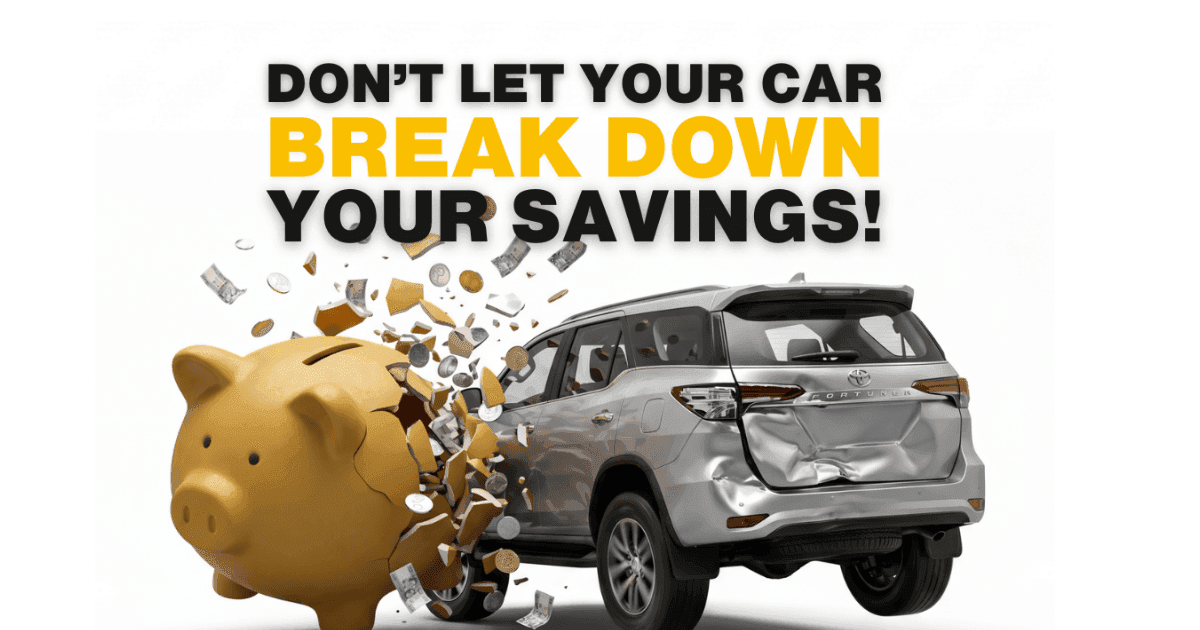
Standard Insurance Comprehensive Car Insurance vs Other Providers in the Philippines
If you’re comparing Standard Insurance with other car insurance providers in the Philippines, the right choice depends less on the brand name alone and more on the exact coverage, deductible, car repair network, claims process, and final premium. Standard Insurance Car Protect is commonly positioned as a comprehensive car insurance option covering Own Damage, Theft, Third Party Property Damage, Excess Bodily Injury, Unnamed Passenger Personal Accident, and optional Acts of Nature coverage.
This guide explains how to make a car insurance comparison against Standard Insurance's comprehensive car insurance without focusing only on the lowest quote.
What should you compare first?
Start by comparing the policy schedule, not the premium amount. In the Philippines, “comprehensive” does not automatically mean every possible road, weather, theft, passenger, or property risk is covered; the policy wording, add-ons, limits, and exclusions decide what you can actually claim.
The Insurance Commission has also noted that comprehensive motor insurance is voluntary and separate from basic CTPL, while Acts of God or Acts of Nature may need to be acquired separately for an additional premium.
A good car insurance comparison should answer five practical questions:
1. What damage is covered?
2. How much will the insurer pay?
3. Where can the car be repaired?
4. How much will you pay per claim?
5. What is the process to file and complete a claim?
Once those are clear, car insurance rates become easier to judge because you can see whether a cheaper policy is genuinely efficient and appropriate for the protection you need.
Comprehensive car insurance in the Philippines explained
Comprehensive car insurance usually gives broader protection than Compulsory Third Party Liability, or CTPL. CTPL is required for vehicle registration and is focused on third-party bodily injury or death; it does not normally pay for your own vehicle repair, damage to another person’s property, theft, flood, or other natural calamity damage. The Land Transportation Office requires it for vehicle registration.
A comprehensive policy may include several coverages:
- Own Damage: repairs to your insured vehicle after covered accidental damage.
- Theft or carnapping: compensation when the insured vehicle or covered parts are stolen, subject to policy terms.
- Third Party Property Damage: protection if you become legally liable for damaging another person’s vehicle or property.
- Voluntary Third Party Liability for bodily injury: added protection beyond compulsory minimums.
- Passenger Personal Accident: benefits for covered passengers and/or the driver, depending on the policy.
- Acts of Nature or Acts of God: flood, typhoon, earthquake, volcanic eruption, and similar natural events when included or endorsed.
- Roadside assistance or towing: useful when the car cannot be safely driven after a covered incident.
The key is to avoid assuming these are all included by default and that one provider's definition of comprehensive car insurance is the same as the others. Standard Insurance’s own educational material says Acts of Nature is not usually part of a comprehensive package unless requested, and the Insurance Commission materials prescribe an AON premium rate and define AON as flood, typhoon, hurricane, volcanic eruption, earthquake, and other convulsions of nature.
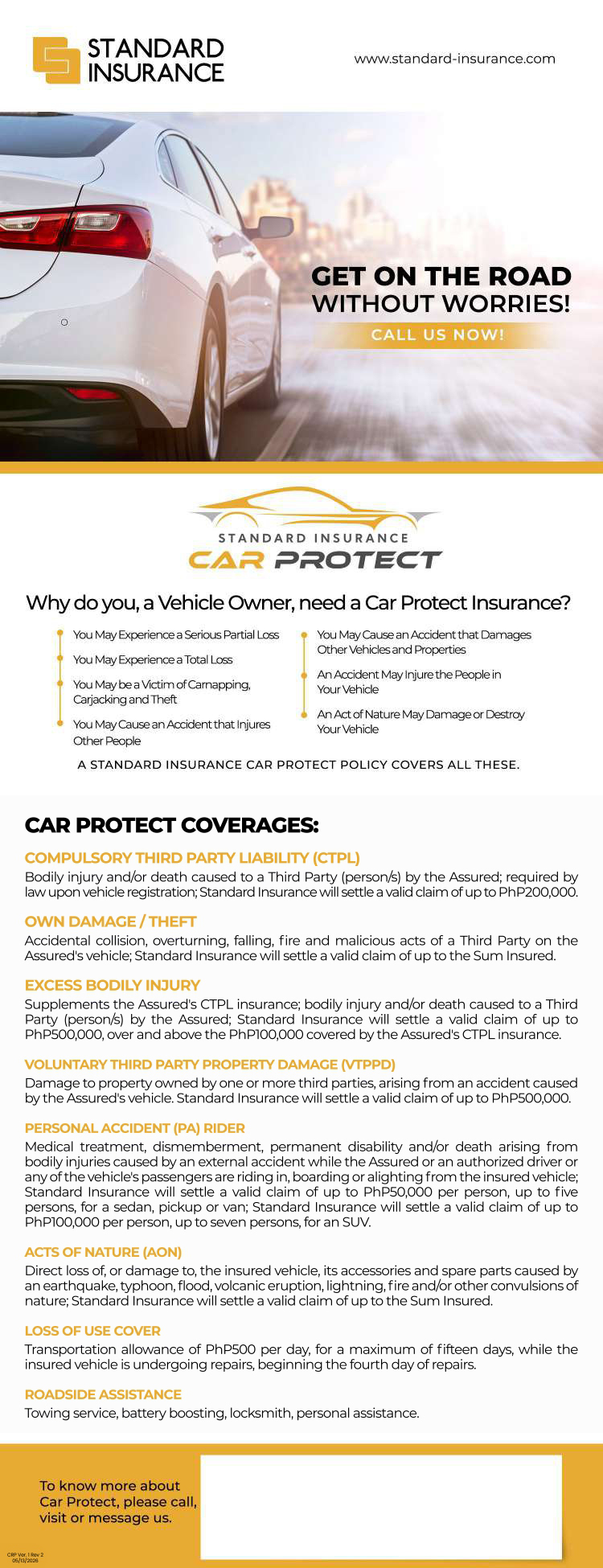
Standard Insurance Car Protect at a glance
Standard Insurance Car Protect is presented as a comprehensive car insurance plan with Own Damage, Theft, Third Party Property Damage, Excess Bodily Injury, Unnamed Passenger Personal Accident, and optional Acts of Nature coverage.
For many Filipino car owners, that structure is the familiar benchmark: it covers the vehicle, expands third-party protection beyond basic CTPL, and lets the owner add natural-calamity protection when needed.
Standard Insurance may be especially relevant if you want a traditional motor insurer with a clear focus on vehicle coverage rather than a highly bundled lifestyle-style package. It can suit drivers who want the standard core protection —accident damage, theft, liability, passenger accident coverage, and AON as needed—and the flexibility of dealing with vehicle dealers, banks, brokers. It is offered via agents, branches, banks, vehicle dealers, in GCash or in the Standard Insurance Car Protect website.
Its published claims guidance also emphasizes a familiar repair workflow:
- Report the claim
- Provide documentation and photos
- Wait for adjuster for assessment
- LOA issuance
- Bring the vehicle to the selected repair shop
While there is no guarantee every claim will be simple, it does show what buyers should look for in any provider: a clear claim path and repair-shop coordination.
How Standard compares with other providers
No single provider is automatically best for every driver. A new financed vehicle, a seven-year-old daily commuter, a flood-prone parking location, and a weekend-only SUV all call for different trade-offs.
This is what we gathered as your potential comparison table:
|
Insurance |
What to check |
Practical implication |
|
Car Protect coverage, AON inclusion, deductible, repair shop options, claims requirements |
Strong candidate given they run their own RAP services under the Standard Insurance Emergency Assist (SIEA), Car Protect gives a broad core motor coverage at a competitive participation fee, offers a loaner car for fleet accounts. |
|
|
Oona |
Packaged plan level, online quote journey, add-ons, workshop choice, starting rates |
Good for shoppers who want plan tiers and digital comparison; published plans show options such as Auto Lite, Auto Premier, and Auto Elite with different benefits and starting premiums. |
|
Malayan |
AutoMaster policy terms, dealership acceptance, claim process, exclusions |
Worth comparing for owners who value an established non-life insurer and want to review detailed policy wording before buying |
|
BPI/MS |
Bank or auto-loan tie-in, renewal lock-in terms, claims contact process, deductible |
Often considered by borrowers or BPI customers; useful when convenience with financing matters |
|
Pioneer |
Motor insurance availability, insurer scale, claim support, agent/broker access |
Relevant for buyers who want to compare large non-life insurers; Insurance Commission data placed Pioneer first in gross premiums written among non-life companies based on 2024 submitted annual statements. (insurance.gov.ph) |
|
Prudential Guarantee |
Auto Insurance Program terms, covered benefits, repair process, intermediary support |
Another major non-life option; public information describes its Auto Insurance Program as offering comprehensive benefits for road mishaps. |
The table should be treated as a buying framework, not a ranking. A provider with a bigger brand, lower premium, or more visible online quote tool may still be less suitable if the deductible is high, AON is excluded, the repair shop is inconvenient, or the third-party limits are too low for your risk profile. For a flood-prone country like the Philippines, always check out how the company runs their Roadside Assistance Program (RAP).
Coverage differences that matter most
The most important differences between comprehensive car insurance providers usually appear in the policy schedule. Two quotes can look almost identical on the first page but behave very differently during a claim.
Own Damage and Theft
Own Damage and Theft are usually the foundation of comprehensive car insurance. In a simple case, this is what helps when your car is damaged in a covered accident or stolen. The Insurance Commission motor car tariff has historically shown private-car Own Damage and Theft rates as a percentage of the sum insured, which is why higher-value vehicles normally cost more to insure.
When comparing Standard Insurance with another provider, check whether Sum Insured is realistic. A premium that looks cheap because the vehicle is undervalued can hurt you later if the car is declared a total loss. A premium that looks expensive may be more reasonable if it uses a higher fair market value, includes better liability limits, or bundles AON and roadside assistance.
Acts of Nature coverage
Acts of Nature is often the deciding factor in the Philippines. Flood, typhoon, and volcanic-related risks are not abstract concerns in many cities and provinces, especially for vehicles parked outdoors, in basement parking, near rivers, or along flood-prone streets.
Standard Insurance materials describe AON as protection against damage directly caused by typhoon, flood, volcanic eruption, earthquake, or other convulsions of nature, but also warn that it is not usually included unless requested.
Oona’s public materials also distinguish basic comprehensive options from plans that include Acts of Nature, showing why buyers should check whether AON is built in or added separately.
Third-party liability and property damage
CTPL alone focuses on third-party bodily injury or death. It does not cover your own vehicle, third-party property damage, theft, or natural disasters. That is why a comprehensive policy with Third Party Property Damage and Voluntary Third Party Liability can matter after a multi-vehicle accident, a collision with a gate, or damage to someone else’s parked car.
Do not compare liability coverage only by whether it exists. Compare the limits. A policy with a higher property damage limit can be more valuable than a cheaper quote with minimal added liability, especially if you regularly drive in dense urban traffic or park near expensive vehicles.
Passenger accident benefits
Passenger Personal Accident coverage can help protect occupants in the insured vehicle, but the covered persons, benefit amount, and conditions vary by policy. Standard lists Unnamed Passenger Personal Accident (UPPA) as part of its Car Protect coverage description. Oona’s brochure also lists UPPA benefits under its auto plans, with limits varying by plan type.
For family vehicles, company cars, or ride-heavy daily use, this section deserves attention. Ask whether the driver is included, how many passengers are covered, and what documents are required for a personal accident claim.
How car insurance rates are usually calculated
Car insurance rates are influenced by the vehicle’s insured value, make and model, age, usage, location, coverage selections, deductible, claims history, and add-ons. Oona’s public FAQ notes that cost depends on factors such as market value, coverage type, added benefits, vehicle age, driving profile, and location.
A practical premium comparison usually looks like this:
- Start with the car’s fair market value. This becomes the basis for Own Damage and Theft pricing.
- Add or confirm AON. The Insurance Commission’s minimum rate for AON has been stated at 0.50%, and its motor schedule also lists AON at 0.50% minimum.
- Choose liability limits. Higher Voluntary Third Party Liability and property damage limits usually increase premium but reduce exposure after a serious incident.
- Review the deductible or participation fee. The Insurance Commission schedule shows a private-car deductible of at least ₱2,000 or 0.5% of the sum insured, whichever is higher.
- Add optional benefits. Roadside assistance, alternative transport, personal belongings, repair-anywhere benefits, and similar add-ons can affect the final cost.
- Check taxes, fees, and authentication requirements. Final payable amounts may include charges that are not obvious in the initial sales pitch.
This is why “lowest premium” is not the same as “best value.” If Standard and another provider differ by a few thousand pesos, the better policy may be the one with clearer AON, lower participation fee, stronger repair access, and higher liability limits.
When Standard Insurance may be the better fit
Standard Insurance may be a good fit when you want a straightforward comprehensive motor policy with the usual protection categories and optional AON. It is also worth considering when your preferred dealership, repair shop, bank, broker, or agent has a smooth working arrangement with Standard, because claims convenience often depends on coordination between the insurer and repair facility.
Standard may also appeal to drivers who want to compare direct renewal or direct quotation options instead of accepting only the dealership’s bundled insurance. If the Standard quote clearly states the insured value, Own Damage, Theft, TPPD, VTPL, passenger accident benefits, AON status, and deductible, you can make a clean apples-to-apples comparison with other providers.
A good Standard quote is not just cheaper; it is clear. Before accepting, confirm:
- Is Acts of Nature included or excluded?
- What is the exact participation fee per claim?
- Is repair available at casa, accredited non-casa shops, or both?
- Are replacement parts subject to depreciation or betterment charges?
- What are the limits for third-party bodily injury and property damage?
- What is the process for obtaining the Letter of Authority?
- What documents are needed for Own Damage, theft, AON, and third-party claims?
When another provider may be better
Choose another provider over Standard Insurance if it offers one or more of the following without weakening essential protection:
- lower deductible for realistic claims;
- included AON rather than optional AON at a similar price;
- better casa or repair-shop access near your home or office;
- faster, clearer digital claims submission;
- stronger third-party liability limits;
- add-ons you will actually use, such as roadside assistance or loaner car.
Red flags when comparing quotes
Some quotes look attractive because they hide trade-offs. Before buying any comprehensive car insurance policy, slow down when you see vague wording, missing coverage lines, or a premium that is far below comparable offers.
Watch for these red flags:
- AON is not shown clearly. If flood or typhoon damage matters to you, it must be stated in the policy schedule or endorsement.
- The insured value is too low. A lower value may reduce the premium but can reduce recovery after a total loss.
- The deductible is unclear. Ask whether it is fixed, percentage-based, or subject to a minimum amount.
- Repair options are limited. A cheap plan may restrict you to selected shops that are inconvenient or not aligned with your vehicle brand.
- Liability limits are too small. Third-party property damage can become expensive quickly in urban accidents.
- The policy excludes your actual use. Commercial use, ride-hailing, delivery, modified vehicles, or undeclared drivers may create claim problems.
- The quote is not from an authorized source. Verify the insurer, broker, or agent through Insurance Commission resources when in doubt. The Commission maintains public lists of companies with valid Certificates of Authority and licensed insurance agents.
A simple decision framework when comparing car insurance
The best provider is the one that gives the strongest usable protection for your actual driving life. Use this framework before choosing Standard Insurance or any other insurer:
- Define your risk. If you park in flood-prone areas, AON is not optional. If you drive daily in Metro Manila or Cebu traffic, liability limits and repair access matter.
- Set a coverage baseline. Require Own Damage, Theft, TPPD, VTPL, Passenger Accident, and AON if your location needs it.
- Get at least three comparable quotes. Ask Standard, one online-first or digital provider, and one dealership- or bank-supported insurer.
- Compare insured value and deductible first. These two items can explain large premium differences.
- Check claims convenience. A slightly cheaper policy can become expensive if repair approval, shop access, or document handling is difficult.
- Read exclusions before payment. Exclusions decide what happens when the claim is not a textbook accident.
- Keep records. Save the quotation, policy schedule, official receipt, photos, and communications with the agent or provider.
This approach keeps the decision practical. It also prevents the most common mistake: comparing only the annual premium while ignoring what happens after an accident.
Final verdict
Standard Insurance comprehensive car insurance is worth shortlisting if you want broad, familiar motor coverage with Own Damage, Theft, third-party protections, passenger accident coverage, and optional Acts of Nature. It is not automatically better or worse than Oona, Malayan, BPI/MS, Pioneer, Prudential Guarantee, or other providers; it depends on the final policy schedule, repair network, deductible, and claims experience available to you.
If two quotes are close, choose the one with clearer AON wording, realistic insured value, reasonable participation fee, accessible repair shops, and stronger liability limits. If one quote is much cheaper, ask what was removed. The best comprehensive car insurance is the policy you can afford, understand, and confidently use when you actually need it.